Showing posts with label Employer Branding. Show all posts

Tuesday, January 28, 2014

HR and Social Media - success by targeting aims properly

From Ralf Junge's blog entry: Erfolgskontrolle von Social-Media-Aktivitäten

By now there is a lot of information about how Social Media Channels can be integrated in Personnel Communication. But the control of success appears to be a challenge for companies still. WHen does Employer Branding via Social Media pays off? With a study KTH Royal Institute of Technology got into the matter of this question just last year. Multiple referents for personnel communication were asked how they measure the success of their activities, what digits matter. What digits show if employer branding via social networks are reaching the pinned goals successfully.


In line of the study the goals of use of Social Media were analyzed. As primary goal Recruitment was identified. Secondary goals are the perception as employer, the attraction of matching candidated, and the development into an 'employer of choice'.

On the basis of these goals exact classification figures can be drawn and defined for the measurement of success. The number of entered application due to Social Media Communication is a significant indicator for fruitful recruiting activities. But not only the quantity of applications, the interaction with the target group show if and how the company is perceived as employer. In its quality again, it shows, if relevant candidates were addressed - got the right target group. The reputation of a company demonstrates (if) Social Media presence influenced the decision of a candidate to chose pro company as employer of choice. Too often though, it is difficult to draw the success of Employer Branding back to Social Media measurements alone. Hence it is advised to include the feedback of candidates when doing the success control.  

What does the control of success at your company look like? 

Ralf

Resources:  Reischauer, Tessa ( 2013): Employer Branding in Social Media – An empirical study on how social media contributes to achieving employer branding aims, KTH Royal Institue of Technology (unveröffentlicht).

Tuesday, January 14, 2014

What happens in HR in 2014

Fram Ralf Junge's blog entry: Das passiert 2014 im HR-Bereich

A new year lays ahead - and with it plenty of new chances, more swing and innovation to be brought into HR. After all reviews on 2013 were written I looked around for trends of 2014. (Latest in twelve months I will see if I was right with my subjects.)

Identity is not only of central meaning for brands but also for users. The page says: "Who you are is increasingly dependent on how you appear online, which pictures you upload, hich groups you belong to and which mindset you present. (...) Brands also know, stiffness and dim appearances of a Corporate Identity are passé. A living identity is only able to be developed by integrating the addressees."

Brand officers are being pushed more strongly to involve their target group when building or adapting an identity. And the target group wants to participate. The great chance in it is to design custom-fit concepts and campaigns. I would wish for it much, especially for the Employer Branding. Hopefully we will see more authentic employer-brands, eventually. 

Candidate Experience after Active Sourcing is the new trend – this labelling appears in plenty of blogs and magazines curently. In leaning on Marketing's Customer Experience Candidate Experience just means and applicants' perception and experience of a company as employer. This implies the complete process, starting from the first contact by a potential applicant to the company over to Onboarding and Retention Management - the Candidate Journey. Naturally, this demands a clear and integrative Employer Brand for a consistent employer brand eyperience.

In this context the often discussed subject of Mobile Recruiting is continueing its relevance and gain in meaning. 

"Classic accession criteria are potential prodigality", according to a thesis by Thomas Sattelberger about labor's future, which was published in last years Handelsblatt (a German economy magazine). In near future things as emotional intelligence and intercultural competence will play a role of increasing importancy in recruiting new employees. The needed occupational expertise can be learned or adapted thanks to the great teaching offers online. Actually I find the idea appealing - recruiters clinging onto résumés but instead checking on how capable a candidate is in order to fulfill the open position. Due to the great diversity of positions and titles capability certainly isn't something to be read from CV's. But do recruiters really want to work without work samples and résumés? What would job-interviews and assessment centers look like then? I wonder, if this way of accession of new employees does prevail. 

One subject I find very interesting is Jobsharing. It means, two persons share one job. The goal is to even out work-life-balance, enabling more time to live. The concept is a great answer to the demand of so many young professionals and offers more freedom. Jobsharing fosters a flexible and more productive working world and definitely is one of my favorite HR-subjects for 2014.  In the coming week I will go into the matter more extensively and show you how Jobsharing can work. 

2014 certainly holds exciting subjects for us and I am looking forward to plenty, new ideas and innovations.

Ralf

Friday, October 11, 2013

Factor: Industry Image - The Ad Industry and its aweful Employer Image

Translated from Jannis Tsalikis' blog entry: Faktor Branchenimage - Beispiel: Die Werbebranche und ihr schlechtes Arbeitgeberimage


In many Employer Branding - Models the industry image plays as actually quite contributing factor a smaller role for the Employer Image of companies. A mistake. It is obvious that the industry image influences the attractivity of corporate brands, and with it its employer brand. (For instance, if fluent in German, check this University paper, page 28, Univ.-Prof. Dr. Christoph Burmann, Das Branchenimage als Determinante der Unternehmensmarkenprofilierung, 2005).
Important "Players" for a good image of an industry are the big, well-known companies of the industry itself as well as the regarding associations, as they are the ones who has the take care of the very industry.

How you should not do it, well, that shows one industry as best, erm worst example: the ad industry.

Since working in this industry (for over 10 years) hardly anything has changed on the fact of "advertiser" being one of the most unfavored vocation.  The image is not new...
Certainly, the in August open letter released by a couple of students from University Pforzheim from Werbeliebe, an association who actually love advertising, is not the first warning to the ad industry. But instead of becoming active and cope with the situation finding a proper solution, the GWA, the association of advertisment agencies reacted (with an attitude *EN), demanding a definition of "appreciation"


Is advertisment really like this!? 39,90 

Last evening, in preparation for this blog post, I started a mini survey (anonymous, 2 questions), asking HR Manager I know. The seven well-experienced colleagues from well-known agencies asked all agreed with me. All answered regarding the sentence: "The GWA engages noticeably for the employer attractivity of the industry, especially regarding winning young talents" with the same - not aggreeing. If the GWA actually understands the signs in this content (this was the second question) is questionable. Here HR's are at odds.
But what to do when the association doesn't do anything? Resign the membership like Serviceplan did? Surely saves a lot of money but won't help solving the problem. 
Catastrophy as a chance? You cannot really free yourself from the industry image. With good Personnel- and Self-PR, however, singly companies can strive and steer against it. This means, though, companies will have to face and appreciate critics and not talk/make them small. In doubt, this means to walk new paths boldly.
Jannis

Sunday, September 15, 2013

Applicants apply at employer always, right? WRONG!

Check out what Andrew Horner, an applicant for Tech in spe did: http://reversejobapplication.com/

Nice idea and yes, much better than LinkedIn or XING. BUT - yes here we go again - as HR headhunting for fitting candidates we all love our profiles which are composed in an equal way. This way we can see what sticks out the most. Imagining reading through a bunch of websites such as these may make us feel closer to the person behind the résumé but it will munch our time away like MyLittlePony Shows my evening. (Yes, this show is stealing my delightful evening plan. Always.)

So, will this reverse application thing become a movement? Especially since more and more companies realize, that they don't pick applicants, but applicants pick employers (when and if they can). Latest when the third applicant rejects an offer for the same position, employers notice that. Walking you talk as company has never been so important as now in the times where CSR and Employer Branding has become a market in themselves.


The thing is, it will NOT become a movement. We, the HR, will not have to look through a googillion of website based vitas. Yes, we admit, one page as CV is almost nothing to see how the person ticks and acts. YET, that is what interviews are for. That's why companies torture their applicants by runnign them through assessment centers. That is what trial period is for. And in the end, it is just less time and as cost efficient as letting HR eyes scan over oh so many resume-ed sites.

It will be interesting on how Applying actually will change in the future. Back then references was everything, now even pre-fixed resumes like the Europass ain't the best. LinkedIn/XING Profiles meh. Jeanne Meister for instance suggests, that there won't be CV's at all one day.

It definitely will be HR-evolutional.


Tuesday, September 3, 2013

Employer Branding and Social Media - still a long way to go

Translated from Ralf Junge's blog entry: "Employer Branding und Social Media – ein weiter Weg."

How does Social Media support the Employer Branding at YOUR company? This is the question of one's master theses I was allowed to read the other day. The subject is quite exciting. After all Social Media has not arrived in HR works completely yet. Very exciting especially with this study is, predominantly only Employer Branding Referents from middle class companies have been asked. 


The use of Social Media in regard of Employer Branding has, as expected, become a top priority in recruting new talents for the own company. Secondary,  the respondents stated their perception as employer, the attraction of matching candidates as well as the development of "employer of choice". Nothing new. More interesting, however, are the named hyrdles coming with the introduction of Social Media:
  1. The implementation IN the company (culture)
  2. The establishing of an authentic Employer Brand
  3. The resourcing of relevant content
  4. The difficulty of measuring the "success"
  5. The integration of the staff
  6. The missing personnel resources, and
  7. The missing strategy

On further research I came to find more interesting things. According to to the Social Media Index, ASMI, only 16 % of German companies have a Social-Media-Strategy for their Personnel Management. That's the snag! I find this number alarming! Social Media definitely is nothing new anymore. Be silent about its effeciency when used - as proven. And this, especially while the younger target group is available mainly and less complicated via Social Media, also.  I am not wondering anymore why sensible and benefitting use of social networks in terms of Employer Branding are NOT working, after all.

By now, the success of the use of Social Media can be measured by KPI. In terms of the study's goals, prior mentioned, HR's named five important indicators, also: The amount of entered applications because of Social Media Communication is one main indicator for activities functioning. The quantity of applications as well as the interaction with the target group show how the company is perceived. On the other hand, in the quality it (should) show, if relevant talents are addressed (properly). The reputation of the company displays clearly, if social media presence influences candidates choosing the company as employer of choice. It is suggested to involve, and even to embrace, the candidates' feedback, also.

All in all, the master thesis does not show any scandalous or pioneering findings. Nevertheless, it shows clearly that it is a long road ahead for successful use of Social Media in terms of Employer Branding. Companies have to work considerably more than what they already did! I suggest we are going to discuss this at the following HR BarCamp in early March of 2014. Maybe we can come up with some useful tips and tricks for all To-Do's. 

Ralf Junge

Friday, August 16, 2013

What does the job as Employer Branding Ambassador look like, Mrs Krämer (SMS Meer)?

Translated from Jannis Tsalikis's blog entry: Wie ist das Arbeitsleben als Arbeitgebermarken-Botschafterin, Frau Krämer (SMS Meer)?


Experts reccomend winning employees to be a representant or ambassador for an employer brand. Reasonable, since employees display an authentic and a somwhat of a live image of the company when being employed there.

At many companies there are still objections and many questions to be answered. I.e., when employees get in contact with applicants, what is being said about the company? Or how can things be redacted or steered then?

The SMS Group does not worry about it at all. The opposite. New is the grant offer and choice of  so called "Karrierebotschaftern" (Career Ambassadors) (also check Stefan Brindt / BPM Blog).

Jannis had the chance to check with Sarah Krämer, talking about her experience as Career Ambassador:

Dear Mrs. Krämer, how did you become an ambassador of and at SMS Group?  

The colleagues responsible for this project asked me. Up front there was an intern selection process where I was suggested. Then all colleagues from different firms and divisions who were asked, also, were invited to a first "GetTogether". There the campain was introduced and our future role and tasks to be were explained to us. Pretty quick after that I decided to be a part of the campaign.

Did co-workers asked you regarding your "new" profile? What's been the feedback? 

Yes, definitely! In the developing phase whith film and photo shoots I was asks frequently for what all this was good for and if there is something new in the making. The feedback was through out positive. My colleagues find this path to be the right and support us as Career Ambassador.

On the site you are automatically invoted to contact you on XING. Does being contacted there happen often? How much work time do you spend on answering applicant requests? 
As of now it is still manageable. The campaign runs on the medial wave which is noticed in the amount of contacts via XING and Mail. Especially when we consult students personally at fairs the contact flow gets stronger. 

Could you tell what is asked usually? And do you answer all questions yourself? 

Most questions are about regular things, such as the hiring procedure or the particular jobs [offered]. Thanks to back-up from the HR division we, Career Ambassadors, can answer the questions ourselves well. Some, however, has to be forwarded to the HR division.

What about spam-request? Is there any? 

No, there has not been any yet.

In a short note: How is it to be ambassador of the SMS Group? 

I am proud to be chosen, and it is nice to give young alumnis something to take with from it.

Mrs. Krämer, thank you for the interview! 

Tuesday, August 13, 2013

HR Innovations - Whatcha Got?

In regard to Ralf Junge's blog entry: Innovationen in der HR-Arbeit – Was? Wer? Wie? Warum?

Last week, Ralf was requesting, well actually demanding rightfully, more progress in HR. This request certainly met open ears of plenty which made Ralf check for more input regarding the key: Innovations. 


Now a lot of companies have tried all kind of existing techniques in HR, went back and forth and eventually got stuck on the level they are now. Most companies even run the, in my opinion, completely wrong way of outsourcing. After all, sites like hr-innovations.com promote it. The from outsourcing being an HR innovation we consider to be truely innovative and less... how to say, culture destroying, is another thing to be discussed. One day folks, one day. ;) 


Back to the actual matter. Ralf knows it from his studies still, and me from my vocational school and the terror of final exams too. The theory "Diffusion of Innovations" by Everett Rogers. The theorem shows and describes the characters and spreading process of innovations. According to Rogers innovation is an idea which is apprehended as "new" to an individual. Over a certain period, this new idea is spread via several channels meeting the members of a social system/ community. That's the diffusion of innovation, or as we Germans would say: innovation diffusion. Yea, say that three times out loud, fast.  But it is easier understood when seen:


Depending on the types shown and the social community targeted, implemetation of such ideas can be approached accordingly. I am not gonna get into this much now. Let's call it suppression. But you definitely should check out the Adoption Lifecycle to find out what kind of "adaptor" you are (English/German)

But I searched for more detail. Again, suppression makes one nosey to find more, differently. And I came across this blog featuring the study by futurestep with the very informative list: 
  • Over three-quarters expect employers to be innovative in the way they retain and engage their staff.
  • 72% expect employers to be innovative in the way they develop people, but only 36% think that their current company is innovative in those fields.
  • 79% agree that innovative approaches to engagement and development would make them more likely to perform better in their jobs.
  • 49% say they would be more likely to take a job advertised or offered in an innovative way, and 51% believe that innovative approaches to recruitment would make them feel more positively about that company overall.

Basically saying: If you (the employer) are not innovative, you loose. 

For more pretty picturized stastics, check this link.

So after Ralf's last weeks request we wanna know: What kind of HR-innovations works best for your company, how was it introduced or applied and why is it working, or not working? 
Who are the Innovators and Early Adopters in HR? Ralf is going to find it out and report for sure. Stay tuned.

Friday, August 9, 2013

EMBARASSING: 300,000 employees not enough - Vacation and Sick Leave totally overrated

From Jannis Tsalikis's blog entry: Ich finde es peinlich und Herr Frank Sennhenn (Vorstandschef DB Netz) findet das irgendwie auch! Fakt ist: 300.000 Mitarbeiter sind einfach zu wenig!

Ladies and Gentlemen, what a ham. Kind of a surprise ham with extra madness on top.
The Deutsche Bahn, biggest company of Germany when it comes to transportation system throughout Germany and a company of 300,000 employees and counting, was totally surprised by, guess what, employees taking vacation days off. Or, awfully rude and inacceptable for calculations obviously, also get sick AND stay at home then. Now the Bahn came to the astonishing conclusion: Without employees, no operation.

Result: Hardly any long-distance train stopping at Mainz since Friday! 


Many Online-News titled - not without the necessary malice (lol) - i.e. the Fokus: "Der Bahn fehlt Personal – Noch weit entfernt vom Top-Arbeitgeber" (Bahn missing personnel - far away from top-employer still). Rightfully, if you ask me. How dare the Bahn to act like some mom-and-pop store? And I'm sorry, Mr. Sennhenn (Chairman of DB Netz), but your whiny apology, erm excuse: "Ja, es ist mir peinlich. Ich möchte mich ausdrücklich bei den Fahrgästen entschuldigen" (Yes, it is embarassing to me. I would like to apologize to all passengers), is ridiculous too.  Have you ever heard something about contractual staff?! What a pitty image this all causes for the Deutsche Bahn. Again.


(For German speakers here the report at SWR)
With such way of acting the laborly built image (pun intended) is torn down in a heart-beat. The million-heavy campaign "Kein Job wie jeder andere" (no job is like the other) was well done...for the trash bin. 300,000 employees are obviously not enough. Mainz needs at least 10 more station inspectors, doesn't it?

Tuesday, July 16, 2013

Bought Employer Reputation - the value of Employer Seals

 Translation from Ralf Junge's blog entry: Erkaufte Employer Reputation – der Wert von Arbeitgebersiegeln


Have you noticed that the (official) Fair Company seal must be paid for in Germany, starting in August?
On request I was told that students were skeptical of so many companies carrying the seal. The selection of companies as well as the missing transparancy were criticized here, also. So they introduced a new quality control with which the opinion of the intern(s) of the particular company builds the basic step for granting the seal.

Till here it is absolutely acceptable. After all such process handling means a certain effort involved which is not always naturally nor understood. Not for nothing it is claimed to be a "seal of surplus value" . So I read  the rules of membership held under the title Media Data. 

I was taken aback bout this matter here for the first time. At the end of the data a nice paragraph declared as "costs of membership" with two different Fair Company packages is stated - combinations with seal of data bank booking and seal of (job-)ad booking for €750 or €1,200. 

Oh yea, since so many companies bought the seal but didn't book anything, the seal now is also supposed to push the ad sales for career portal of the Handelsblatt, a German newspaper. Of course all in front of the background of a new quality management process being introduced anew. With this kind of jumble the seal certainly has a weird flavor . Yet, it isn't the only employer certification or - seal involving costs as these. 

I ask myself a couple of questions here: Is the Employer Reputation purchasable? What is such seal worth then? How credible and valid are such audit procedures? Do career starters actually know and use these seals for orientation for choice of employer? 

Considering the last question especially, I stumbled upon several companies publically displaying such seals but never explaining anything themselves nor linking them to the explanation by the seal's public site. Basically making this whole thing redundant!

My request to you hereby is: Ask your applicants and new colleagues, if they actually know the seal or are influenced by it.

RJ

Tuesday, July 2, 2013

Creative ways in Recruiting and Personnel Marketing

Translated from Ralf Junge's blog entry: Kreative Wege im Recruiting und Personalmarketing

The shortage for skilled talents is sharpening up. It definitely is not enough to just publish a job-ad online or offline nor presenting yourself at job fairs or to brace oneself with certificates, waiting for the right applicants to to come. It is not going to happen! Other companies with more innovative strategies will be much faster.

More and more companies have their recruiting values within the networks of their employees. With incentives of high bonuses employees are helt motivated to support the Recruiting in search of skilled talents in shape of employees' friends, associates and family members. In the June edition of brandeins Magazine, which I mentioned in my last post also, it read the company Eventbrite costs its recruiting employees incentives up to $2.500. The firms keep counterbidding themeselves in the so called war for talent. 

But money is not everything. Recruiting also is about catching eyes. Here we can learn a lot from the advitising sector which spice up their activities in Recruiting and Personnel Marketing with all kinds of creative ideas. By now, even here, in the pretty and colorful world of Ad and Media the war for talented minds. Here Agencies focus on much attention of their target group as well as the Surprise-Effect. With means such as the "Guerilla-Recruiting". 

One of the most famous example in Germany is probably the case of "Pizza Digitale"  by Scholz & Friends Hamburg. With a QR-Code on Pizzas (Yes, on real edible Pizzas) Digital Talents were searched for. With each order of Pizza by an agency the customer had one Pizza Digitale delivered additionally.  

With another creative idea  - the trojan portfolio - the Agency Jung von Matt was looking for the best Art Directors. Multiple Photographers were sent off to other ad-agencies to (under cover) apply with their portfolio. On one of the work sample the job-ad was (hidden) displayed. 

Besides such Recruiting activities, firms use plenty means to style up their job-place. Yes, job- Place. Massages, kicker-tables, sport activities or snack and coffee machines - all actions are about attracting new and retaining employees. (Kind of) Giving them the feeling to be proud to work at their company. 

The conventional means will not work for much long though. Now, creative and innovative ways are demanded. The young academics want to be wooed for and convinced about haven chosen the best employer. I'm excited to see the what ways and means for more attention companies chose in future. 

RJ

Tuesday, June 18, 2013

Understanding the meaning of one's job

Translated from Ralf Junge's blog entry: Den Sinn der eigenen Arbeit im Unternehmen verstehen 

When I walked by the newspaper stand last week, I noticed the current edition of the brandeins magazine right away. The brandeins magazine writes about all happenings regarding the economy worldwide, yet main focus is on Germany. The magazines cover displays a thinking bubble saying "Mondays, I could puke". This editions main subject: Motivation. 

 This triggered my curiousity since I busy myself with this on a daily basis as well on how bind employees to our company for the long run. Motivation, of course, is a key factor also. 

One of the most important motivators and drives in companies is the leading Management. Besides focussing on achieving company goals the leading Management has to actually care about the people who work with them. Potentials and talents have to bee spotted and accordingly pushed as well as clear opportunities for development have to be displayed. Kept in mind, every single employee is part of the whole thing called company. Nonetheless, everybody has to understand his or her personal distribute to their employing company and its advantage(s). As stated in the cover-article "Brennen. Ohne zu verbrennen" (engl: Burning. Without burning up.), Supervisors/Managing Members together with their staff have to discover the meaning and sense of everyone's personal situation. Turning the co-worker into a co-entrepreneur, giving them greater authority over their own responsibility, it says. This motivates and means and underlines appreciation. Hereby the company says through its behavior: you are important to us doing the job (daily) contributing to the company's success. 

Employees, especially young employees just int he beginning of their career, are longing for seeing and having a sense in their daily work. This motivates. Companie,  having no sense and (higher) meaning in their daily tasks, will have problems finding great talents to staff. Brandeins here named Banks and Insurances as examples for those being confronted with this kind of situation in nearest future. Special opportunities, however, have the new and innovative small to medium classed companies since they are more lucrative to and for young career starters. 

Overall the brandeins article doesn't show any new spectacular perception, nevertheless it shows again what is important to thesedays career beginners - no steeply rising careers nor status symbols, but sense-making work in order to contribute meaningfully and know one's adding to a companies success.

RJ

Friday, June 7, 2013

Sloppy Baden-Württemberg Campaign. Isn't it?

Translated from Jannis Tsalikis's blog entry: Baden-Württemberg versaloppert sich mit "La deutsche Vita"! Oder?

The German Federal State of Baden-Württemberg became famous in Germany with the great Scholz & Friends Campaign "Wir können alles. Außer Hochdeutsch." (We can [do] everything. But High German). Meanwhile the German Agency "Hirschen" are taing care of this Client and its Campaign (W&V). I know, it is old hat. Yet, this week the Ad "La deutsche Vita." (an homage to la dolce vita, turned into la German vita) crossed my view in the Magazine "brandeins", and I asked myself: Has Baden-Württemberg became sloppy with this Employer Branding Camapign?! I know, I must lean over this Window too much. Especially since the site www.bw-jetzt.de  is highly spoken of. However, let us debate a little.


In the Ad it says i.e. "Besonders gerne kombinieren wir besonders Gutes miteinander: etwa spannende Jobs mit entspanntem Dolce Vita. Das Ergebnis? La deutsche Vita!" ("We love to combine the very good Things: for instance exciting Jobs with a relaxed Dolce Vita. The result? La deutsche Vita") Ah! Alrighty, thanks! The Advertisement and Website is packed with such creative Sentences which are Fun. But is it convincing?
There are no Hints or Links to a (or the) Company which possibly could hold such Promise. (Editors Note: Besides that, do Employees even get the Chance to encounter la dolce Vita much as desired? Check this older blog entry.) Same dissonant Scene you can currently find on its Facebook Profile. Little to less authentic Posts. So it won't make you wonder about the less participated "Liking" on the 31 May Post about the "La deutsch Vita"-Motive with the Sentence "Das Leben ist euch nicht dolce genug? Kommt nach Baden-Württemberg!" ("Life is not dolce enough? Come to Baden-Württemberg!") receiving a total of 12 Likes when having 7,000 Fans on FB - odd and bad, let's pretend the current floodings are responsible for the low Participation on BW's Facebook *EN.

W"hat do you think about this? Does this Campaign even make Sense?


JT

Tuesday, June 4, 2013

Axel Springer looking for talented Fellow Traveller

Translated from Ralf Junge's blog entry: "Mitreisende gesucht"


The Digital Natives grew up with modern Technology. The Internet has become a part of everyone's daily life. Networking and Information in  real-time are important to them. 

Now another Generation is entering the Job Market. The Specialists and Leaders of tomorrow are certainly wooed which is why more and more Companies are focussing their Personnel Marketing Activities to be channelled on and to them.  Media Company Axel Springer is staging itself with a  founding   legend of great digital companies such as Apple or Google. 

"It doesn't matter where you come from. As long as you know where you want to go" are the final words of the Video displayed above. The Media House wants to strengthen its Position as Connoisseur of the Digital Industry and launches this new Campaign as Recruiting-Medium in hopes of finding qualified Talents who will join the Companie's Journey towards being the "leading digital Media Company". There is a lot in the pipeline,for instance, a Media Campus is supposed to be  sprouting up in Berlin, Germany. On top of that Axel Springe is supporting the Start-Up Event-Line "hy!", which is taking place in Berlin as of now.

In September 2012 already, BILD-Chief Editor, Kai Diekmann, travelled to the Silicon Valley so he could catch a glimpse of the local Start-Up Scene and of course for networking with such. Where his Journey took him, you can see at his optical Metamorphosis into a Nerd. Surely looking forward to the Media House's development.

Axel Springer succeeds in drawing Interest and Attention with this rather unusual and blahblah-less Personnel Marketing Campaign.

RJ

Friday, May 24, 2013

Employer Dialogues online: Welcome to the Conversation - or Babble - Society

Translated from Jannis Tsalikis' blog entry: Arbeitgeberdialoge im Web: Willkommen in der Konversations- oder Laber-Gesellschaft?

Communication today means Conversation. Those in HR avoiding such will encounter problems in Personnel Recruiting. Especially, because these and the coming new generations demand an instant feedback on their questions and applications. These rather new demands on employers ask for a radical rethinking. Human Resourcer and and Recruiter will have to be approachable and, also, answer! They are the face and voice of the company in terms of Staffing and Staffing-to-be. The (now) classic way via E-Mail or via XING, LinkedIn, Facebook or Twitter - Answers are expected. Companies will have to adjust to these wishes and necessarily provide the addressable representatives for its career page. This is not easy, since there are many colleagues in the personnel department who are not coming into question for this very matter. BUT, it could look as nice as Otto Group has displayed and actually does it, as you find below.


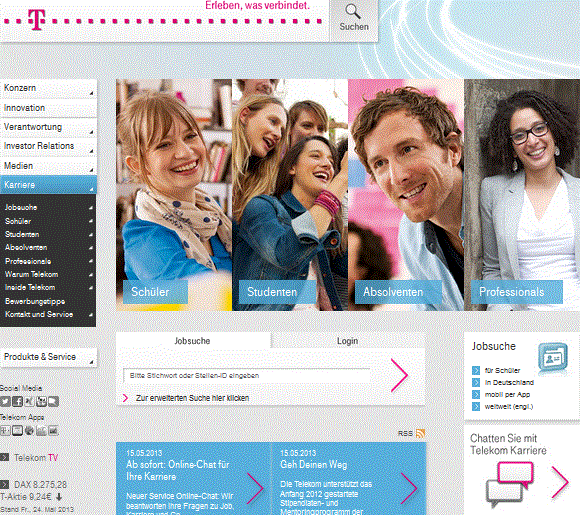
It says "We are glad to be there for you!". These tendencies is clear, and, reversible. Some companies are one step ahead. Those offer the option of a Chat right on their career site. With the example, Telekom (gloabally better known as T-mobile), we can see how this works. Homepage of the career site, bottom right corner, it says: "Chat with Telekom Career!"


With one "click!" a Chat-Window opens. Yet, the dialogue followed is rather disappointing. You will not get any insider-information from the HR Department, but a navigation help to the career site at best. A dialogue kind of looks like this: 

Jannis: Hello, Mr Welter,
Stefan: Godd Day Jannis
Stefan: What can I do for you?
Jannis: I wanted to know, if I can apply simply with a PDF or if it is always via Data-Mask only... and 
Jannis: if you have any vacant positions in the HR field  for a Professional as me. 
Jannis: (I work and live in Berlin)
Stefan: under the following Link you can find all vacant position at Deutsche Telekom. 

Uh, really?! I sure didn't know this. Does that kind of dialogue even make any sense? 

Maybe, it is because these kind of chats are handled by bigger Dialogue-Centres. But I am sure this will change and develope to a better and especially helpful level.
JT

Friday, May 17, 2013

Human Resources loves Public Relations!


Translated from Jannis Tsalikis' blog entry: Human Resources liebt Public Relations! Review der Veranstaltung des lprs Forum
The Leipziger Public Relations Studenten (Public Relations Students of Lepizig) invited for a panel today: "HR vs. PR - Wer hat die Lizenz zur Personalkommunikation?" The students approached precarious questions very conscientiously and seriously as the M16, and assemled TOP-Teams of experts. For those who are having a fair command of German may find this very interesting. We find it to be a great Intro-Film, which the students made and cut for this event specifically:


As you may have noticed in the preview already, I was featured also.  I was allowed to contribute a prolog to this discussion and feed students with info to the topic Personnel Communication since it was pretty unknown to most. And I made it clear:  HR loves PR!


Versus why versus?! Of course, it were meant the specialty departments and the alleged fight about the "honey pots" ( translated quote: Twitter, Jeannette Gusko @JeanneRaffut). While this panel, however, it becomes clear, PR and HR (can) go together only. Yet it is an open end to wether which party, HR or PR, is    ruling the roost. Here the audience was at variance till the very end.

For a lot of students who attended it was quite an illumiative evening. If you wanna practice some more German you can follow up with the thread of the debate on Storify:

Monday, May 6, 2013

Work-Life-Balance was yesterday - today we embrace Work-Life-Choice


Last week the Online Start-Up Twago announced the resignation of its founder and Managing Director, Gunnar Berning. (Twago is an online project tool bringing Companies and Freelancer together by offering posted projects and profiles of Freelancer.)  At this juncture the differing views of the Managing Board as well as the Investors regarding expansions have been the crucial reason for this decision. More interesting, and shocking also, I found the news about the lay-off of another twenty to thirty employées along Bernings leaving. Considering of Twago only having sixty employées in total this is a very drastic decision.

However, this is what a job at a Start-Up often entails. At least, here in Berlin, the founder city Germany´s, it is not something of rarity. Primarily a young firm represents itself as IN, dynamic and innovative. Self-realization, flat hierarchies, responsibilty and promotion prospects are embraced vocabularies in terms of Start-Up's. It is true, naturally. The authority given is inviting much. Certainly, one can take a lot of responsibility within a short time already. That is surely a great feature on the résumé, also.


Start-Ups, nevertheless, are forefeiting their good image. More often you can hear about harsh working conditions. But why is that? In contrast to bigger companies and combines working hours in Start-Ups are significantly higher which leads back to the shortage of resources, such as work force, as well as missing structures. It feels like working without a break when being employed at a Start-Up company. Yes, it brings great responsibility to be taken, yet, a private life is often something not to even think of having. There is no Work-Life-Balance. It is more likely a Work-Life-Choice. Salaries come substantially smaller than in big and established companies. 

You might ask, why would one work at a Start-Up then anyways?! Well, everybody applying and being hired at a Start-Up usually know exactly what they are engaging in, which is why it is called Work-Life-Choice in the first place. Thus a conscious decision pro such working conditions.

It is everything BUT a boring office job with structured daily schedules and detailed processes and structures to encounter. The real charme lays in being constantly confronted with challenges anew and having the chance to create and frame the firm actively. And this most often within a young team and a great corporate culture which is based on team spirit and a great potion of motivation.

RJ